

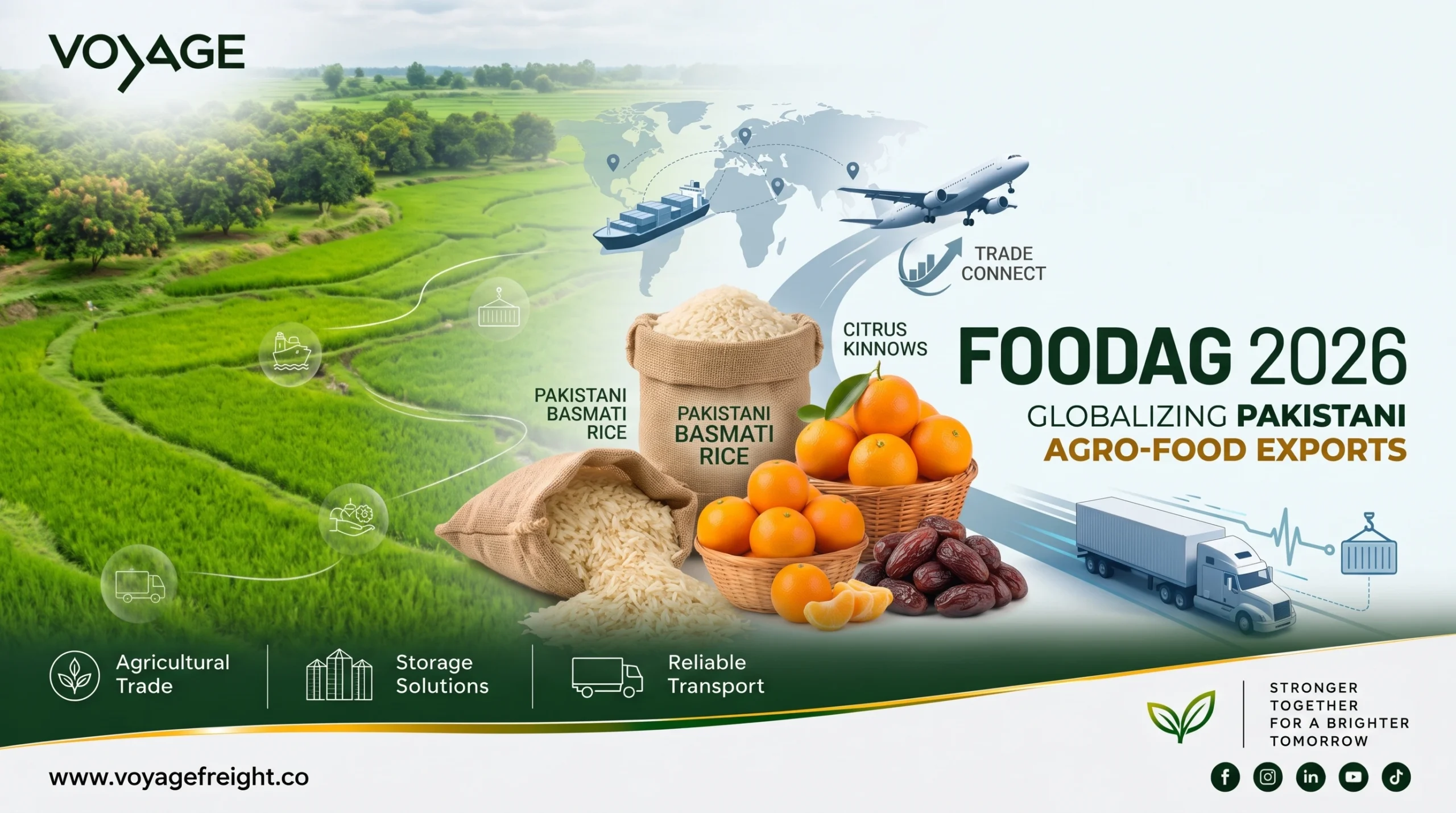
FoodAg 2026 Generates $658 Million in Expected Business: Key Deals, SME Growth, and Export Takeaways
Global demand for Pakistani produce, grains, and value-added food products just took a major step forward. During the first two days of FoodAg 2026—the 4th International Food and Agriculture Exhibition organized by the Trade Development Authority of Pakistan (TDAP) at the Karachi Expo Centre (November 23–26, 2026)—exporters generated $658 million in expected business, including $50 million in confirmed export contracts.
With 400 Pakistani exhibitors across more than 20 agro-food sub-sectors engaging over 900 international buyers from 80 countries, the event marks a pivotal recovery moment for Pakistan’s food export economy. Following a 29% dip in overall food exports during FY2025–26 ($5.02 billion) and a 12% year-on-year rebound in Q1 FY2026–27 ($1.24 billion), the momentum on the exhibition floor signals renewed buyer confidence across Gulf, Asian, European, and African corridors.
FoodAg 2026 at a Glance: Key Commercial Milestones
More than 4,000 B2B meetings took place in the opening 48 hours across rice, processed foods, seafood, meat, cereals, and oilseeds. On the sidelines, exporters signed 16 Memoranda of Understanding (MoUs) and formal export contracts covering high-volume shipments:
Fresh Kinnows: 15,000 Metric Tonnes (MT) – International Buyers (Export Commitment)
Yellow Maize: 10,000 MT – International Buyers (Export Commitment)
Fresh Pineapples: 5,000 MT – International Buyers (Export Commitment)
Dates (Annual Supply): 864 MT ($820,800/year) – China (Export Contract)
Dates, Dry Fruits & Organics: $70 Million Combined – World Level Supply Chain (China) [3 SMEDA-Facilitated MoUs]
Beyond these headline volumes, Pakistani firms forged distribution and sourcing partnerships in seafood, Basmati and non-Basmati rice, spices, rock salt, and confectionery with buyers from China, the United Kingdom, Vietnam, Bangladesh, and the Gulf—including Kuwaiti importers establishing long-term supply chains for private-label rice, spices, and condiments.
SMEDA Unlocks $70 Million in SME Export Partnerships
One of the clearest proof points from FoodAg 2026 is how institutional matchmaking helps regional Small and Medium Enterprises (SMEs) enter high-volume international supply chains. Facilitated by the Small and Medium Enterprises Development Authority (SMEDA), three Pakistani agribusinesses signed MoUs totaling $70 million with Chinese buyer World Level Supply Chain (represented by CEO Cathy Chen):
Salman Dates: $30 million MoU
Chaman Dry Fruits: $20 million MoU
Organic Grower: $20 million MoU
Trade Diplomacy and Chamber-Led Market Expansion
FoodAg 2026 also functioned as an active hub for bilateral trade diplomacy. TDAP Chief Executive Faiz Ahmad and Secretary Sheryar Taj held strategic meetings with official delegations from the European Union, China, Malaysia, Saudi Arabia, Kenya, Argentina, Russia, and Rwanda to discuss market access, seed cooperation, and agro-industrial joint ventures.
At the private-sector level, the Federation of Pakistan Chambers of Commerce and Industry (FPCCI) and the Karachi Chamber of Commerce and Industry (KCCI) hosted targeted B2B sessions with business delegations from Uzbekistan, Uganda, Malaysia, China, and Bahrain, opening non-traditional trade lanes in Central Asia and East Africa.
Three Export Readiness Takeaways from the Policy Seminars
To ensure that signed MoUs convert into repeat shipments rather than one-off inquiries, TDAP paired exhibition matchmaking with technical dialogues led by trade, regulatory, and logistics authorities:
Strict Sanitary and Phytosanitary (SPS) Compliance: Briefings by the Department of Plant Protection (DPP) emphasized that meeting quarantine, residue, and certification rules is non-negotiable for retaining access to the EU, China, and Gulf markets.
Digital Customs & End-to-End Traceability: A dedicated seminar featuring Adil Majeed (Trade Specialist, Pakistan Single Window), Brig Nasir Zia (Retd) (COO, National Logistics Corporation), and Shaukat Ali highlighted how digital trade documentation and farm-to-port cargo traceability reduce clearance delays and strengthen international buyer confidence.
Brand Protection & Regional Market Strategy: Sessions led by Hafiz Aziz ur Rehman (Chairman, Intellectual Property Organisation) and Dr. Mubarak (Consultant, TDAP) underscored the importance of Geographical Indication (GI) protection for Basmati rice alongside tailored entry strategies for Saudi Arabia’s expanding food retail market.
Key Takeaway & What Comes Next
Generating $658 million in expected business within two days confirms that international buyers view Pakistan as a competitive source for grains, horticulture, and specialty foods. Over the next several quarters, the exporters who capture the greatest share of this $658 million pipeline will be those that pair competitive farm-gate pricing with verifiable traceability, SPS compliance, and reliable cold-chain execution.
Source: Express Tribune